Patagonia Shop Used PDP Component
Patagonia Shop Used PDP Component
This project required balancing commerce performance, brand trust, and circularity goals within one of Patagonia.com’s highest-traffic surfaces. I partnered closely with engineering, merchandising, Trove and the Worn Wear team to design a flexible component that respected existing PDP behaviors while introducing resale in a way that felt seamless, credible, and easy to act on.
This project required balancing commerce performance, brand trust, and circularity goals within one of Patagonia.com’s highest-traffic surfaces. I partnered closely with engineering, merchandising, Trove and the Worn Wear team to design a flexible component that respected existing PDP behaviors while introducing resale in a way that felt seamless, credible, and easy to act on.
Role
Lead Designer
Role
Lead Designer
Timeline
May 2024 - October 2025
Timeline
May 2024 - October 2025
Status
Launched January 2025
Status
Launched January 2025
View Experience
Role
Lead Designer
Timeline
May 2024 - October 2025
Status
Launched January 2025

The Problem & Point of View
The Problem & Point of View
The Problem & Point of View
Before this project, customers did not encounter used products anywhere within the Patagonia.com shopping experience. The only path to resale was through global navigation to the Worn Wear site, requiring customers to leave Patagonia.com entirely.
As a result:
Customers shopping new products were never exposed to used alternatives at the moment of purchase consideration
Resale lived outside the core commerce flow, making it invisible during one of the most important decision-making moments
Patagonia had limited insight into how customers evaluate used products in the context of shopping new
Compounding this challenge, most Worn Wear inventory does not have a perfect match to new Patagonia products. This raised a critical design question:
Would customers meaningfully consider used options if they weren’t exact matches?
Rather than treating used gear as a separate destination, I aimed to understand how customers would actually respond to seeing used options, whether they are exact or similar matches, alongside new products on Patagonia.com.
To ground this work in real behavior, I ran usability testing and synthesized findings through affinity mapping to understand how customers evaluate used inventory, where hesitation shows up, and what drives confidence.
Key Takeaway:
Customers value seeing used options while shopping new. They trust Patagonia’s quality, prioritize size availability, and are open to similar used styles when exact matches aren’t available.
↓ Image: Affinity map synthesizing usability testing insights around size availability, similar matches, trust, and resale awareness.
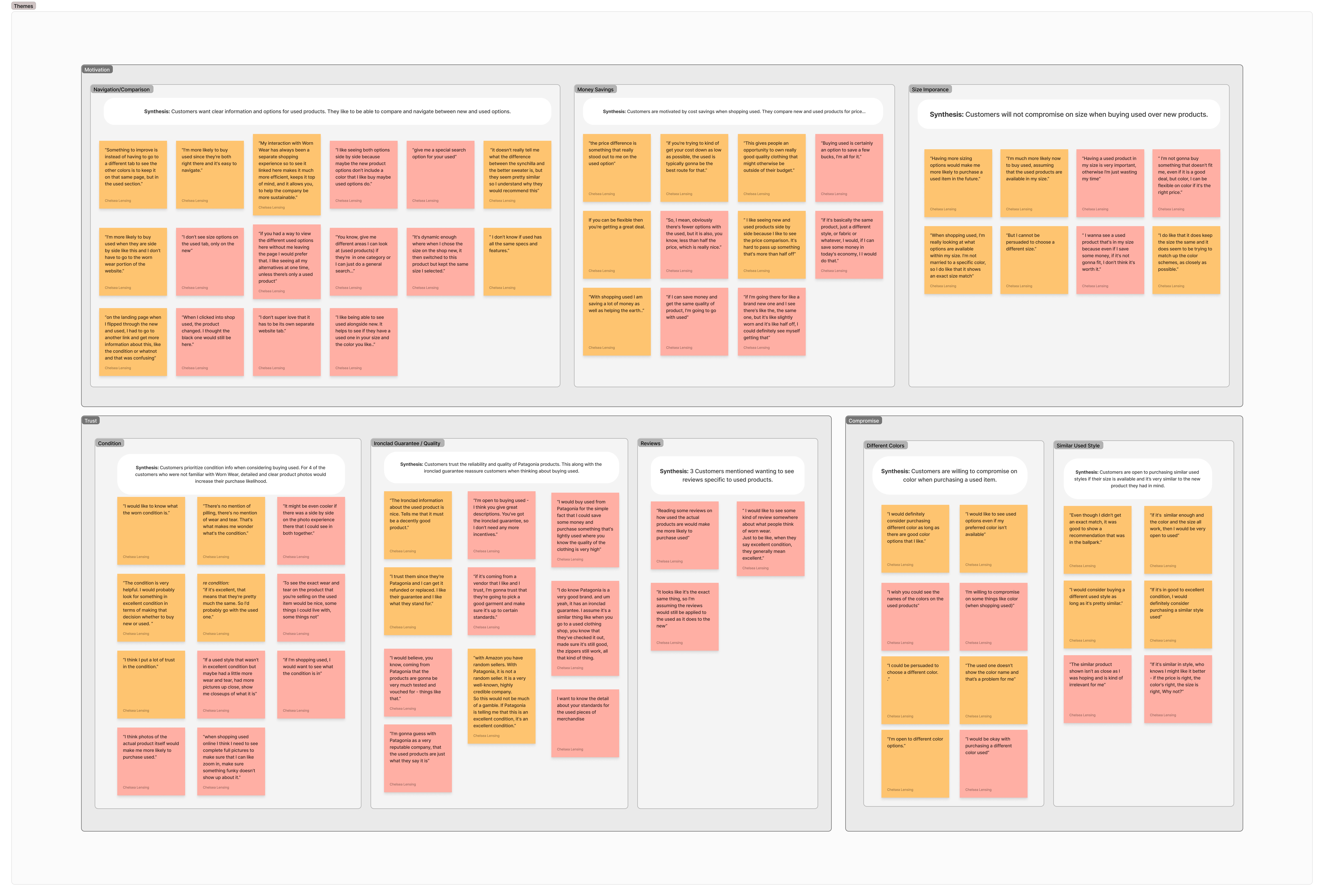
Before this project, customers did not encounter used products anywhere within the Patagonia.com shopping experience. The only path to resale was through global navigation to the Worn Wear site, requiring customers to leave Patagonia.com entirely.
As a result:
Customers shopping new products were never exposed to used alternatives at the moment of purchase consideration
Resale lived outside the core commerce flow, making it invisible during one of the most important decision-making moments
Patagonia had limited insight into how customers evaluate used products in the context of shopping new
Compounding this challenge, most Worn Wear inventory does not have a perfect match to new Patagonia products. This raised a critical design question:
Would customers meaningfully consider used options if they weren’t exact matches?
Rather than treating used gear as a separate destination, I aimed to understand how customers would actually respond to seeing used options, whether they are exact or similar matches, alongside new products on Patagonia.com.
To ground this work in real behavior, I ran usability testing and synthesized findings through affinity mapping to understand how customers evaluate used inventory, where hesitation shows up, and what drives confidence.
Key Takeaway:
Customers value seeing used options while shopping new. They trust Patagonia’s quality, prioritize size availability, and are open to similar used styles when exact matches aren’t available.
↓ Image: Affinity map synthesizing usability testing insights around size availability, similar matches, trust, and resale awareness.
Before this project, customers did not encounter used products anywhere within the Patagonia.com shopping experience. The only path to resale was through global navigation to the Worn Wear site, requiring customers to leave Patagonia.com entirely.
As a result:
Customers shopping new products were never exposed to used alternatives at the moment of purchase consideration
Resale lived outside the core commerce flow, making it invisible during one of the most important decision-making moments
Patagonia had limited insight into how customers evaluate used products in the context of shopping new
Compounding this challenge, most Worn Wear inventory does not have a perfect match to new Patagonia products. This raised a critical design question:
Would customers meaningfully consider used options if they weren’t exact matches?
Rather than treating used gear as a separate destination, I aimed to understand how customers would actually respond to seeing used options, whether they are exact or similar matches, alongside new products on Patagonia.com.
To ground this work in real behavior, I ran usability testing and synthesized findings through affinity mapping to understand how customers evaluate used inventory, where hesitation shows up, and what drives confidence.
Key Takeaway:
Customers value seeing used options while shopping new. They trust Patagonia’s quality, prioritize size availability, and are open to similar used styles when exact matches aren’t available.
↓ Image: Affinity map synthesizing usability testing insights around size availability, similar matches, trust, and resale awareness.
Research, Decisions & Design
Research, Decisions & Design
Research, Decisions & Design
Turning insights into product decisions:
The usability findings clarified how customers evaluate used inventory when shopping new. With those insights in hand, the focus shifted from whether customers would consider used options to how the experience should behave across real inventory scenarios.
The design challenge was to translate those learnings into a system that could scale beyond perfect matches while maintaining clarity, trust, and relevance.
Key insights that shaped the solution:
Size availability is the primary driver when customers evaluate used options
Customers are comfortable with similar styles when exact matches aren’t available, as long as the product feels comparable
Placing used inventory alongside new supports awareness without disrupting shopping behavior
Customers unfamiliar with Worn Wear want clearer signals around condition and guarantees
Designing for real inventory scenarios:
Based on these insights, I focused on designing a flexible system that could adapt to multiple states without confusing or overwhelming the customer.
Key design decisions included:
Using the UI to communicate that selecting a size improves used recommendations
Treating both exact and similar matches as intentional and valid outcomes
Designing clear fallback states when no used inventory is available
Embedding used options close to new product information to support natural comparison
↓ Image: Early low fidelity design exploration for the shop used component on the PDP.
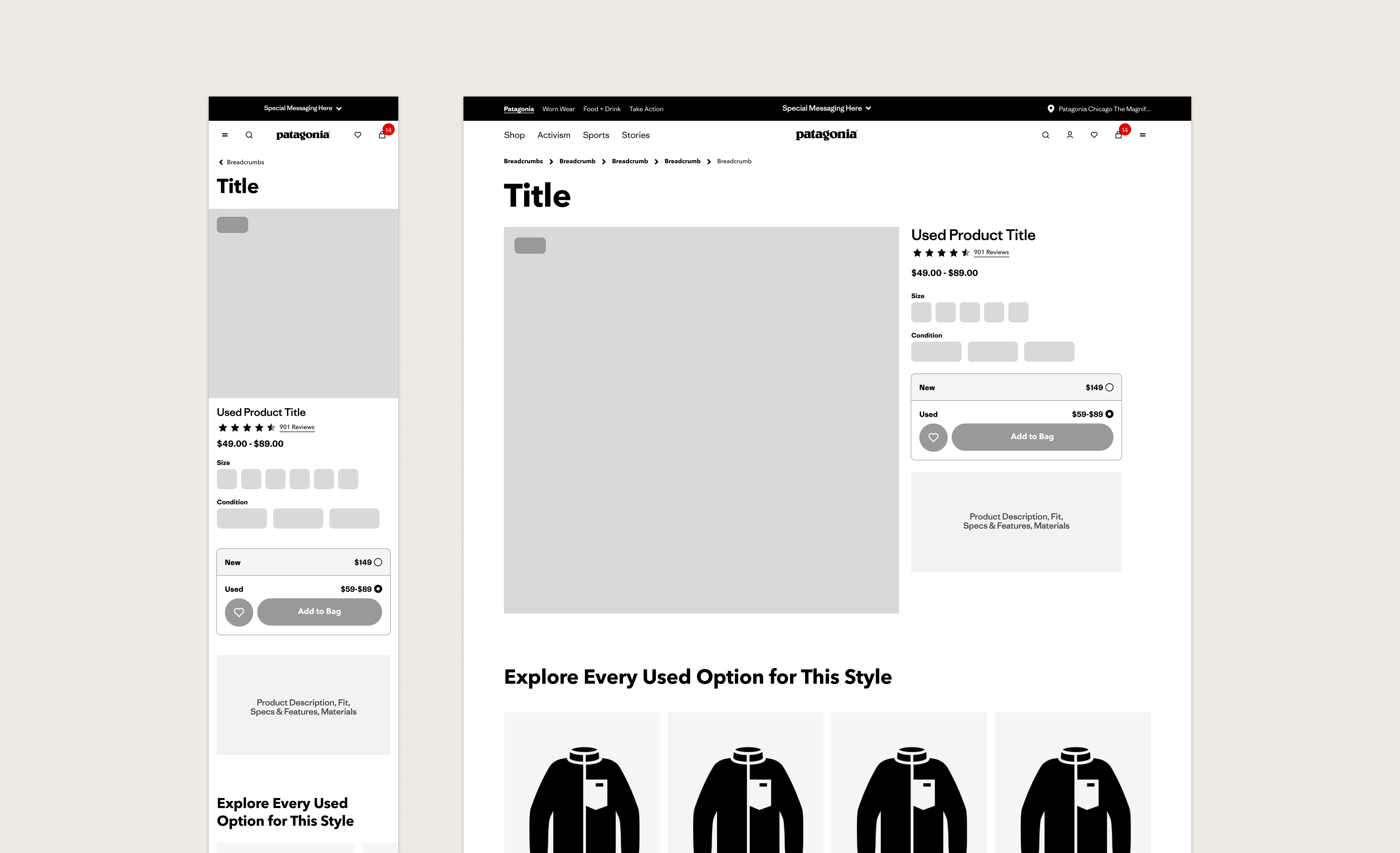
Turning insights into product decisions:
The usability findings clarified how customers evaluate used inventory when shopping new. With those insights in hand, the focus shifted from whether customers would consider used options to how the experience should behave across real inventory scenarios.
The design challenge was to translate those learnings into a system that could scale beyond perfect matches while maintaining clarity, trust, and relevance.
Key insights that shaped the solution:
Size availability is the primary driver when customers evaluate used options
Customers are comfortable with similar styles when exact matches aren’t available, as long as the product feels comparable
Placing used inventory alongside new supports awareness without disrupting shopping behavior
Customers unfamiliar with Worn Wear want clearer signals around condition and guarantees
Designing for real inventory scenarios:
Based on these insights, I focused on designing a flexible system that could adapt to multiple states without confusing or overwhelming the customer.
Key design decisions included:
Using the UI to communicate that selecting a size improves used recommendations
Treating both exact and similar matches as intentional and valid outcomes
Designing clear fallback states when no used inventory is available
Embedding used options close to new product information to support natural comparison
↓ Image: Early low fidelity design exploration for the shop used component on the PDP.
Turning insights into product decisions:
The usability findings clarified how customers evaluate used inventory when shopping new. With those insights in hand, the focus shifted from whether customers would consider used options to how the experience should behave across real inventory scenarios.
The design challenge was to translate those learnings into a system that could scale beyond perfect matches while maintaining clarity, trust, and relevance.
Key insights that shaped the solution:
Size availability is the primary driver when customers evaluate used options
Customers are comfortable with similar styles when exact matches aren’t available, as long as the product feels comparable
Placing used inventory alongside new supports awareness without disrupting shopping behavior
Customers unfamiliar with Worn Wear want clearer signals around condition and guarantees
Designing for real inventory scenarios:
Based on these insights, I focused on designing a flexible system that could adapt to multiple states without confusing or overwhelming the customer.
Key design decisions included:
Using the UI to communicate that selecting a size improves used recommendations
Treating both exact and similar matches as intentional and valid outcomes
Designing clear fallback states when no used inventory is available
Embedding used options close to new product information to support natural comparison
↓ Image: Early low fidelity design exploration for the shop used component on the PDP.
The Solution & Impact
The Solution & Impact
The Solution & Impact
The Solution:
Design exploration through edge cases, collaboration with a multitude of stakeholders and Trove, led me to the final design of the Shop Used PDP component. The component surfaces exact or similar secondhand inventory directly on new product detail pages on Patagonia.com. For the first time, customers can evaluate used options without leaving Patagonia.com, alongside the product they were already considering.
The component was designed to:
Integrate seamlessly into the PDP without interrupting the primary purchase flow
Adapt to multiple inventory states (exact match, similar match, no inventory)
Scale as resale inventory grows, while maintaining clarity and trust
View the final specs and wireframes in Figma →
Why It Works:
By embedding resale directly into the shopping journey, the experience supports natural comparison rather than forcing customers into a separate decision path. Customers can quickly assess availability, size, and relevance, making used clothing and gear feel like a credible, intentional option that supports Patagonia's brand values and commitment to circular systems.
Designing for both exact and similar matches ensured the component remained useful even when inventory was limited, reflecting the realities of resale without degrading the experience.
Impact:
The Shop Used PDP component launched in October 2023 in partnership with Trove and exceeded expectations:
Engagement with used gear grew 50X: from only 1% of product detail page visitors clicking through to Worn Wear, to 50% of those who engaged with the component continuing on to shop used.
22% of purchasers were new to Patagonia DTC
The launch of the component contributed to Worn Wear’s strongest Q1 to date
The work positioned resale as a core part of Patagonia.com, not a separate destination, furthering the brand’s circularity goals
↓ Image: A single component designed to adapt across exact matches, similar recommendations, and fallback states, both with and without size selected.
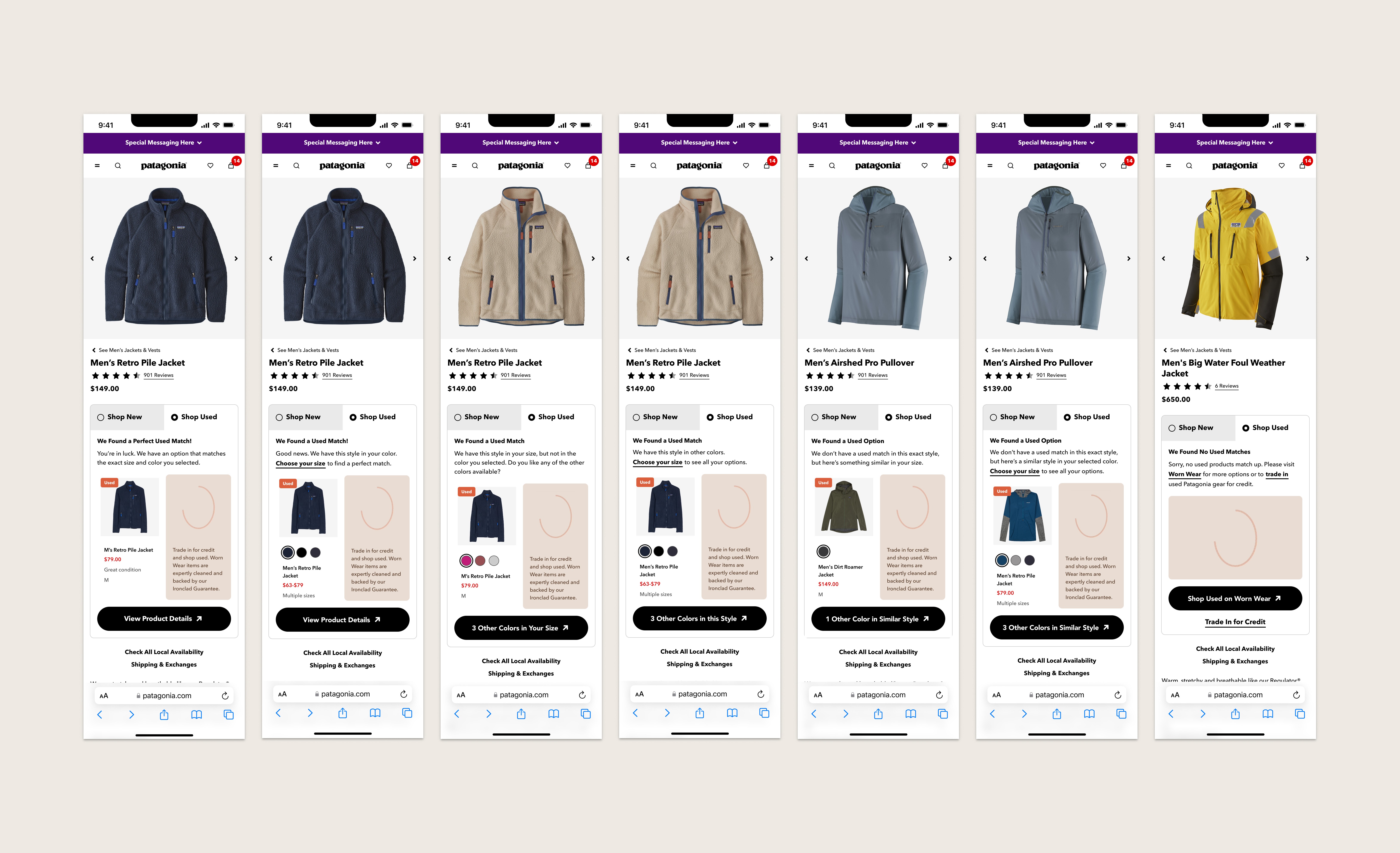
The Solution:
Design exploration through edge cases, collaboration with a multitude of stakeholders and Trove, led me to the final design of the Shop Used PDP component. The component surfaces exact or similar secondhand inventory directly on new product detail pages on Patagonia.com. For the first time, customers can evaluate used options without leaving Patagonia.com, alongside the product they were already considering.
The component was designed to:
Integrate seamlessly into the PDP without interrupting the primary purchase flow
Adapt to multiple inventory states (exact match, similar match, no inventory)
Scale as resale inventory grows, while maintaining clarity and trust
View the final specs and wireframes in Figma →
Why It Works:
By embedding resale directly into the shopping journey, the experience supports natural comparison rather than forcing customers into a separate decision path. Customers can quickly assess availability, size, and relevance, making used clothing and gear feel like a credible, intentional option that supports Patagonia's brand values and commitment to circular systems.
Designing for both exact and similar matches ensured the component remained useful even when inventory was limited, reflecting the realities of resale without degrading the experience.
Impact:
The Shop Used PDP component launched in October 2023 in partnership with Trove and exceeded expectations:
Engagement with used gear grew 50X: from only 1% of product detail page visitors clicking through to Worn Wear, to 50% of those who engaged with the component continuing on to shop used.
22% of purchasers were new to Patagonia DTC
The launch of the component contributed to Worn Wear’s strongest Q1 to date
The work positioned resale as a core part of Patagonia.com, not a separate destination, furthering the brand’s circularity goals
↓ Image: A single component designed to adapt across exact matches, similar recommendations, and fallback states, both with and without size selected.
The Solution:
Design exploration through edge cases, collaboration with a multitude of stakeholders and Trove, led me to the final design of the Shop Used PDP component. The component surfaces exact or similar secondhand inventory directly on new product detail pages on Patagonia.com. For the first time, customers can evaluate used options without leaving Patagonia.com, alongside the product they were already considering.
The component was designed to:
Integrate seamlessly into the PDP without interrupting the primary purchase flow
Adapt to multiple inventory states (exact match, similar match, no inventory)
Scale as resale inventory grows, while maintaining clarity and trust
View the final specs and wireframes in Figma →
Why It Works:
By embedding resale directly into the shopping journey, the experience supports natural comparison rather than forcing customers into a separate decision path. Customers can quickly assess availability, size, and relevance, making used clothing and gear feel like a credible, intentional option that supports Patagonia's brand values and commitment to circular systems.
Designing for both exact and similar matches ensured the component remained useful even when inventory was limited, reflecting the realities of resale without degrading the experience.
Impact:
The Shop Used PDP component launched in October 2023 in partnership with Trove and exceeded expectations:
Engagement with used gear grew 50X: from only 1% of product detail page visitors clicking through to Worn Wear, to 50% of those who engaged with the component continuing on to shop used.
22% of purchasers were new to Patagonia DTC
The launch of the component contributed to Worn Wear’s strongest Q1 to date
The work positioned resale as a core part of Patagonia.com, not a separate destination, furthering the brand’s circularity goals
↓ Image: A single component designed to adapt across exact matches, similar recommendations, and fallback states, both with and without size selected.